


Managing Uncertainty. Protecting Value. Enabling Better Decisions.
Every strategic decision carries uncertainty.
Organisations do not create value by eliminating risk—they create value by understanding, governing and managing risk intelligently.
The VODIS Enterprise Risk Governance Framework™ provides a structured governance model that integrates strategic, operational, financial, technological and regulatory risks into a unified decision-making process.
Rather than treating risk management as an isolated compliance activity, the framework embeds risk governance into business strategy, operational execution and organisational decision-making.
Risk becomes part of the way organisations operate—not an activity performed after decisions have already been made.
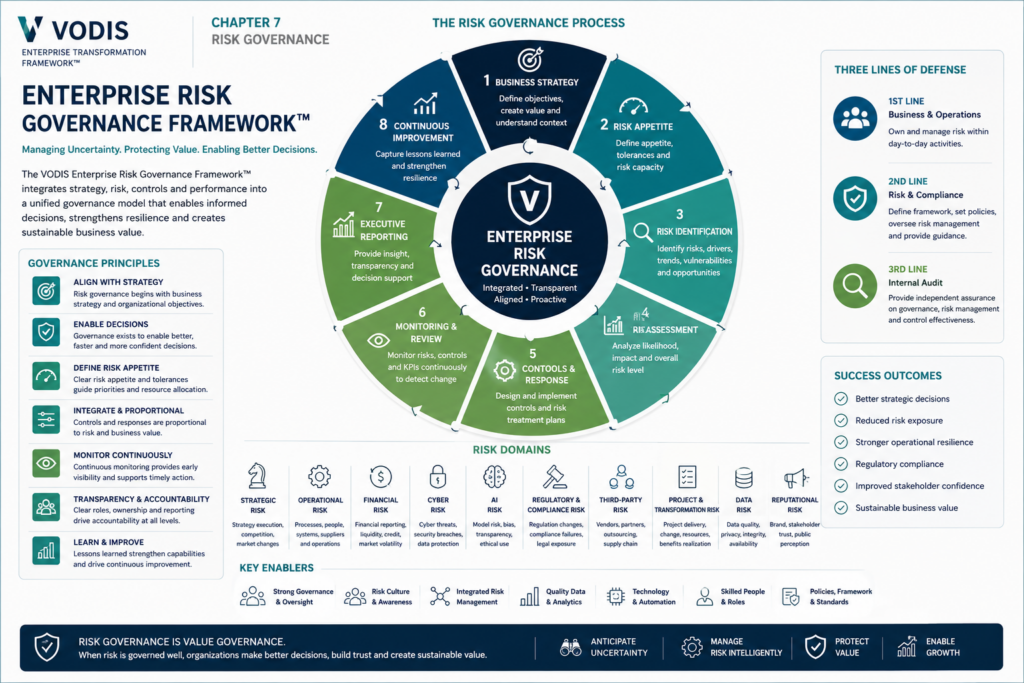
Enterprise Risk Governance Framework™
A Business-Driven Approach to Risk
Modern organisations operate in environments characterized by continuous change.
Cybersecurity, Artificial Intelligence, digital transformation, regulatory evolution, geopolitical uncertainty and third-party dependencies continuously reshape organisational risk profiles.
Managing these risks independently creates silos.
Managing them together creates resilience.
The Enterprise Risk Governance Framework™ connects risk identification, governance, operational controls and executive oversight into a single integrated operating model.
Risk Governance Domains
The framework integrates:
- Strategic Risk
- Operational Risk
- Financial Risk
- Cyber Risk
- AI Risk
- Regulatory & Compliance Risk
- Third-Party Risk
- Project & Transformation Risk
- Data Risk
- Reputational Risk
Each domain contributes to a comprehensive understanding of enterprise exposure while supporting informed executive decision-making.
Governance Principles
Effective risk governance is based on several fundamental principles:
- Risk awareness begins with business strategy.
- Governance must enable—not slow down—decision making.
- Risk appetite should be clearly defined and continuously reviewed.
- Controls should be proportional to business value.
- Monitoring must be continuous rather than periodic.
- Transparency builds executive confidence.
- Lessons learned strengthen future resilience.
Why It Matters
Organisations that integrate risk governance into everyday management become more agile, more resilient and more competitive.
The objective is not to avoid uncertainty.
It is to make better decisions despite uncertainty.
Because risk governance is ultimately about protecting business value while enabling sustainable growth.
Looking Beyond Traditional Risk Management
At VODIS, we believe that enterprise risk governance continues to evolve.
Traditional risk management has historically focused on identifying, assessing and mitigating risks. However, emerging methodologies increasingly seek to integrate risk into business performance, decision-making and organisational value creation.
One particularly interesting development is the concept of Risk Accounting, promoted by the Risk Accounting Standards Board (RASB). Rather than treating risk solely as a compliance or reporting exercise, Risk Accounting proposes a structured approach for measuring and quantifying non-financial risk exposure as an operational business metric, enabling organisations to better understand the relationship between risk, controls, operational performance and business value.
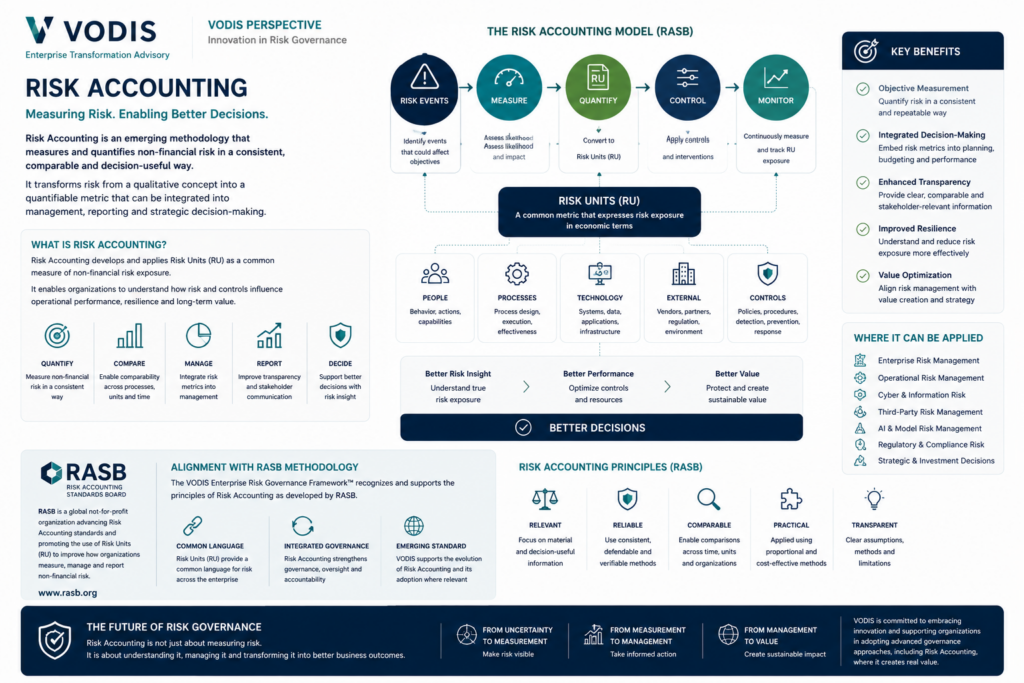
While the methodology continues to evolve, we believe that concepts such as quantifiable risk exposure, continuous risk measurement and integrated governance will become increasingly important for modern organisations.
The VODIS Enterprise Risk Governance Framework™ has therefore been designed to remain compatible with emerging governance models and future developments in enterprise risk management, including innovative approaches such as Risk Accounting, operational resilience, AI governance and integrated performance management.
Because the future of governance is not only about managing uncertainty.
It is about measuring it, understanding it and transforming it into better business decisions.