


We help organisations strengthen cyber and operational resilience in general, through pragmatic cybersecurity transformation initiatives adapted to their operational realities and business criticality.
This includes operational assessments, rapid risk mitigation measures, security governance alignment, audit and compliance support, awareness initiatives and integration of scalable security operations capabilities.
VODIS supports organisations in building sustainable cybersecurity environments through operational integration, external SOC collaboration or development of internal monitoring and response capabilities.
Operational Resilience Framework™
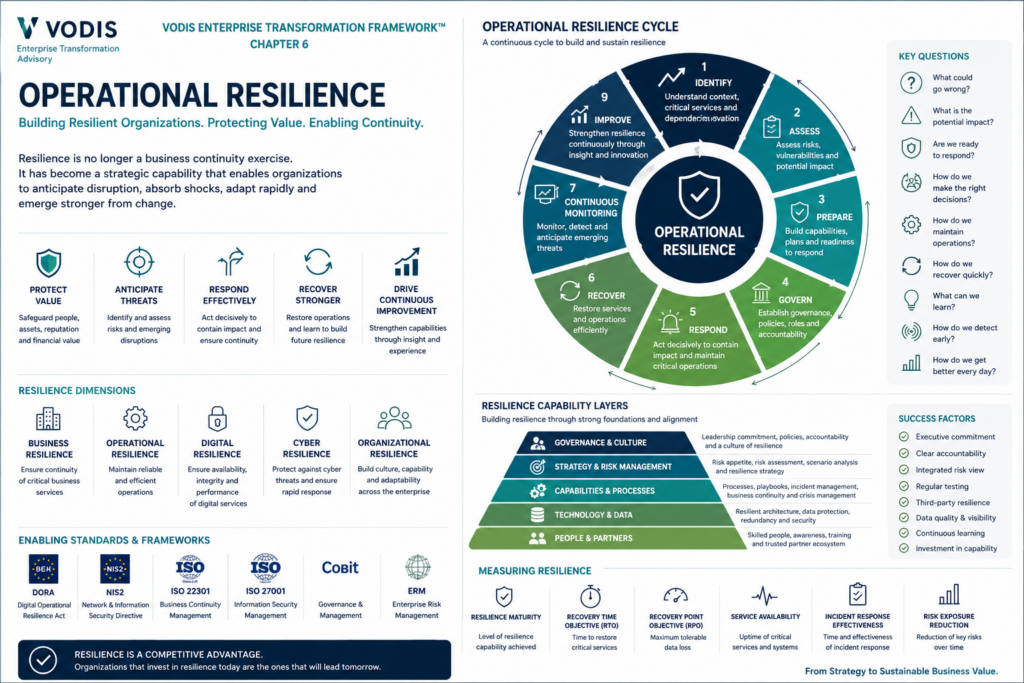
Building Resilient Organisations. Protecting Value. Enabling Continuity.
Business resilience is no longer limited to disaster recovery or business continuity planning.
Today’s organisations operate in an increasingly complex environment where cyber threats, regulatory changes, geopolitical uncertainty, supply chain disruptions, operational failures and emerging technologies continuously reshape business risk.
Resilience has therefore evolved into a strategic organisational capability.
The VODIS Operational Resilience Framework™ provides an integrated methodology for helping organisations anticipate disruption, strengthen preparedness, respond effectively, recover rapidly and continuously improve their ability to operate under changing conditions.
Rather than treating resilience as an isolated function, the framework integrates governance, risk management, operational processes, technology, cybersecurity, business continuity and organisational capabilities into one coherent operating model.
The Operational Resilience Cycle
The framework follows a continuous improvement lifecycle composed of nine interconnected stages.
1. Identify
Understand the business environment, critical services, strategic objectives, dependencies and potential sources of disruption.
The objective is to answer a simple but fundamental question:
What could prevent the organisation from achieving its objectives?
2. Assess
Evaluate threats, vulnerabilities, business impact, operational dependencies and organisational exposure.
Risk is assessed not only from a cybersecurity perspective, but across the entire enterprise.
3. Prepare
Develop organisational capabilities before disruption occurs.
Preparation includes governance, policies, resilience plans, awareness, exercises, technology readiness and operational capabilities.
Prepared organisations respond faster.
4. Govern
Effective resilience requires structured governance.
Roles, responsibilities, escalation mechanisms, executive oversight and decision-making processes ensure that resilience remains embedded within normal business operations.
Governance transforms resilience from a project into an organisational capability.
5. Respond
When disruption occurs, organisations must react quickly, consistently and effectively.
The framework supports coordinated incident response, crisis management, executive decision-making and business communication while minimising operational impact.
6. Recover
Recovery extends beyond restoring systems.
The objective is to restore business capabilities, customer services and operational performance while maintaining confidence among stakeholders.
Organisations should emerge stronger than before the disruption.
7. Continuous Monitoring
Modern resilience requires continuous visibility.
Business indicators, operational metrics, cyber events, technology performance and emerging risks are monitored continuously to detect change before disruption becomes business impact.
8. Improve
Every disruption creates knowledge.
Lessons learned, operational feedback, audit findings and performance indicators become inputs for strengthening resilience across the enterprise.
Organisations continuously mature rather than returning to their previous state.
9. Sustain
Operational resilience is not a project.
It is an organisational capability that evolves together with strategy, technology, governance and business priorities.
Continuous investment in resilience creates long-term competitive advantage.
Resilience Dimensions
The framework integrates five complementary resilience domains:
- Business Resilience
- Operational Resilience
- Digital Resilience
- Cyber Resilience
- Organisational Resilience
Together, these dimensions ensure that resilience becomes part of everyday business operations rather than an emergency response activity.
Governance & Capability Layers
Operational resilience depends upon multiple organisational capabilities working together.
The framework combines:
- Governance & Leadership
- Strategy & Enterprise Risk Management
- Business Processes & Operational Controls
- Technology & Information Systems
- People, Skills and Organisational Culture
Each layer reinforces the others, creating a resilient operating model capable of adapting continuously to changing business environments.
Measuring Resilience
Resilience should be measurable.
Typical indicators include:
- Organisational Resilience Maturity
- Recovery Time Objective (RTO)
- Recovery Point Objective (RPO)
- Critical Service Availability
- Incident Response Effectiveness
- Risk Exposure Reduction
- Operational Readiness
- Business Continuity Performance
Measurement transforms resilience from an abstract concept into an operational management capability.
Why Operational Resilience Matters
Organisations rarely fail because a disruption occurs.
They fail because they are unable to adapt.
Operational resilience enables organisations to anticipate uncertainty, protect business value, recover quickly and continuously improve.
It transforms uncertainty into preparedness and disruption into organisational learning.
Because resilience is no longer simply about surviving change.
It is about using change as a source of long-term competitive advantage.